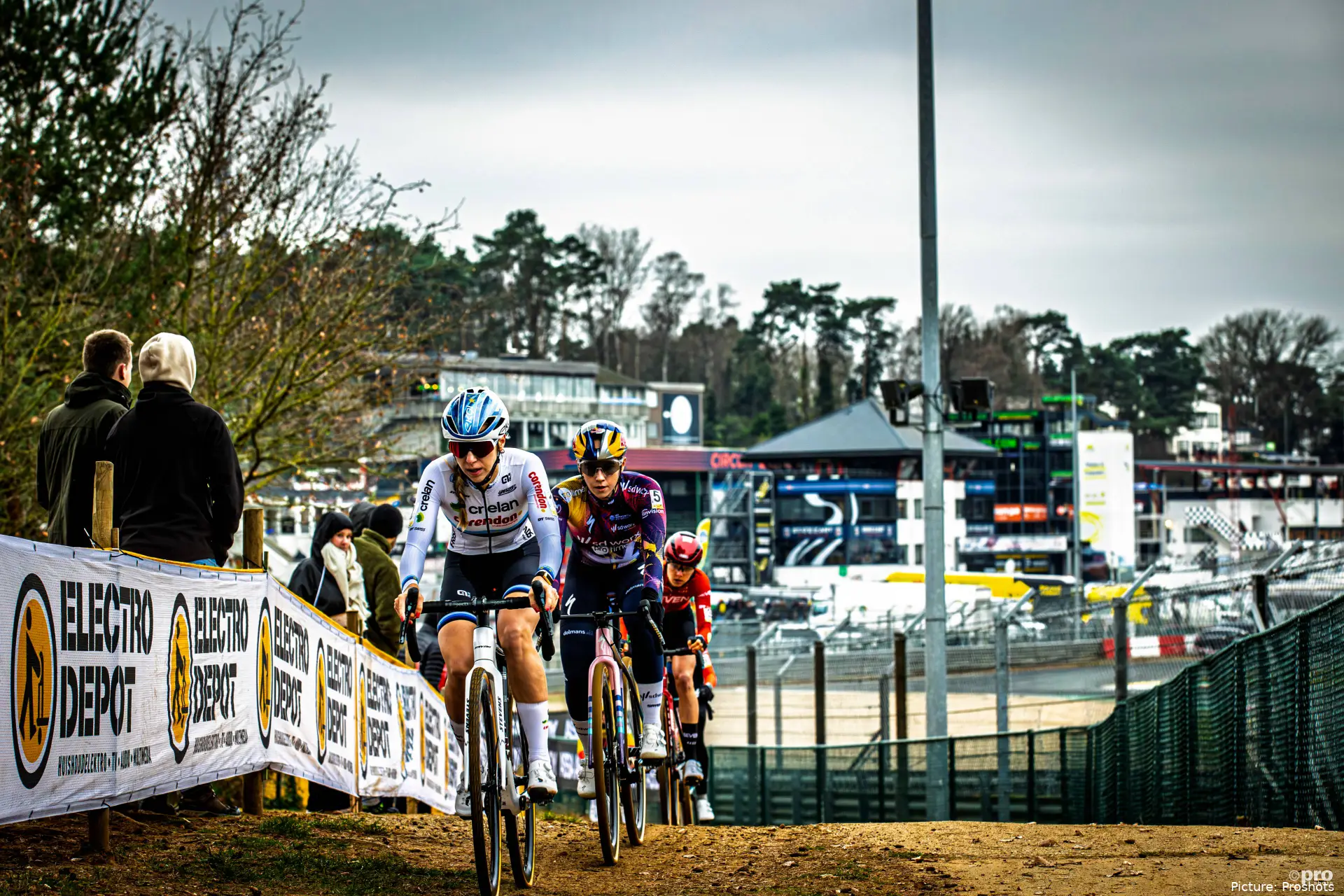
A flight of roughly 100 steps could help decide the next European cyclocross champions. Zeddam in the Netherlands will host the championships on 7 and 8 November 2026, bringing a major international cycling event back to the village 20 years after it staged the World Championships.
The setting gives the weekend an immediate identity. Riders will face repeated changes between pedalling, running and carrying their bikes, with little opportunity to recover after a mistake. For spectators, that makes cyclocross unusually easy to follow even without knowing every name on the start list.
Unlike an online casino game, where the published rules remain consistent between rounds, a cyclocross race can change considerably as the ground deteriorates. A corner that riders negotiate comfortably during practice can become a problem after rain or several earlier races.
A championship returns to familiar ground
Zeddam hosted the Cyclocross World Championships in 2006, when Belgium’s Erwin Vervecken won the elite men’s title and Marianne Vos took the elite women’s crown. This November’s European Championships return international championship racing to the Gelderland venue, with competitions across junior, under-23 and elite categories.
That history matters because cyclocross venues develop reputations through particular obstacles and memorable races. Fans often recognise a climb, a sand section or a steep descent before remembering the complete result.
For riders, however, previous editions offer only limited guidance. Changes to the circuit and different ground conditions mean the current course must be learned on its own terms. Familiar surroundings do not guarantee familiar racing.
The first practice laps will help teams establish where riders can overtake, where running might be quicker than riding and which sections could cause congestion during the opening lap.
The staircase could split the field
Organisers have announced a 2.97km circuit with a rebuilt staircase approximately three metres wide and a new 60-metre riders’ bridge. The route broadly follows the 2006 course, with adjustments designed by Vervecken himself.
The staircase creates a specific physical challenge. Riders must dismount smoothly, lift the bicycle and maintain speed while climbing on foot. At the top, they need to remount without hesitation and accelerate before the next rider closes the gap.
A poor transition costs more than the time lost during the mistake. It can also leave a competitor behind a slower rider, forcing another acceleration when an overtaking opportunity finally appears.
Repeated efforts make those small losses significant. A rider who gives away a second during each dismount may eventually need a much harder effort elsewhere simply to remain with the same group.
The width should allow racing rather than a single queue, but positioning before the steps will still matter. Entering the section near the front gives a rider more freedom to choose a rhythm.
Six titles across two days
The published programme places the junior women, under-23 men and elite women on Saturday 7 November. Sunday follows with the junior men, under-23 women and elite men.
Both elite races are scheduled for 15:00 local time, which is 14:00 in the UK. The organisers list Inge van der Heijden and Toon Aerts as the reigning elite European champions. Their eventual participation, alongside the rest of the field, should be checked against the final national selections.
The schedule also makes the earlier races worth watching. Junior and under-23 competitions reveal how the surface is behaving before the elite events begin.
A visible racing line may become faster as loose material is cleared. Alternatively, repeated use can create deeper ruts and make a previously straightforward section harder to ride. Teams watching those races can gather useful information without sending their own riders onto the course.
Why tyre choice will matter
Cyclocross equipment decisions are closely connected to conditions. Tyre tread and pressure affect grip, rolling resistance and the rider’s confidence through corners.
A faster tyre can be attractive on firm ground, but insufficient grip may force a rider to brake earlier or dismount more often. A more aggressive tread can help in softer conditions while creating a different compromise on harder sections.
Pressure requires similar judgement. Riders need enough support to protect the wheel and maintain control, but an excessively firm setup can reduce traction over uneven ground.
There is no useful universal answer before the weather and surface are known. Teams will refine their choices during reconnaissance, and a change in conditions could make those decisions relevant again shortly before the start.
For viewers, repeated slips in the same section are worth noticing. They may indicate a difficult line, unsuitable equipment or a rider struggling to maintain technique under fatigue.
The opening lap can shape the whole race
Cyclocross begins with an intense effort to reach the first narrow sections in a good position. Riders further back can lose time through congestion even when they make no mistake themselves.
That creates a difficult balance. Starting too cautiously risks being trapped behind traffic. Starting too aggressively can leave a rider struggling to recover once the field settles.
The strongest riders also need to decide when to attack. An acceleration before a technical section can force rivals to enter it under pressure. Attacking immediately afterwards may work better if opponents are still trying to regain speed.
At Zeddam, the most revealing moments may therefore happen around the obstacles rather than on them. Watch who reaches the steps first, who remounts cleanly and who can accelerate again without looking strained.
By Sunday afternoon, the European titles could depend on exactly those details. The staircase will attract the cameras, but the winning advantage may be built through a succession of cleaner corners, quicker transitions and better decisions over the entire circuit.

Kieran WoodDeputy Editor-in-Chief
Kieran Wood is a sports journalist based in Wales and has been active in journalism since 2022. He regularly contributes to DartsNews.com and CyclingUpToDate.com, where he covers professional cycling and darts. In cycling, his work includes liveblogs from major races, including the Tour de France, the Giro d’Italia, and La Vuelta a España, alongside race reports and analysis. He has also conducted interviews with professional riders.
His reporting spans the full racing calendar, from one-day classics to stage races, with a focus on accurate, real-time coverage and clear contextual analysis. For statistics, results, and historical context, he regularly uses resources such as ProCyclingStats. To support reporting on rider activity and training context where relevant, he also references Strava.
In his work, Kieran places strong emphasis on careful sourcing, editorial accuracy, and updating articles as new, verified information becomes available.
claps 0visitors 0
Just in

Popular news
Latest comments
- disrespectful thats a joke ...
 Davide20-10-2026
- EF’s “island of misfit toys” squad is probably one of my favorites in the peloton. They are fun to watch, always trying stuff - they ride with heart and panache, and their kits are excellent.wrsty20-10-2026
- 'Children these days'... Wout, since the caveman learned to say "Ug", older generations have always said this about younger generations. Not every young rider is a cowboy. So what's to say that the fact that Poels was respectful meant that his peers were equally so?
 Rafionain-Glas19-10-2026
- "...In a weakened field" Most definitely ! YAWN !frieders319-10-2026
- Noted. But I had to appease his fans.MajorPayne19-10-2026
- I wonder if he'll race Challenge MallorcaRafionain-Glas19-10-2026
- Head to head time-splits: Jay Vine vs Remco Evenepoel: 10.5 km - Vine lost 45 seconds to Evenepoel 34.2 km - Vine lost a further 1:10, and was caught in the vicinity of that checkpoint. Note: I remember Vine getting caught before the second checkpoint, and ProCyclingStats log supports that, however, the gap at the second checkpoint was less than 2 minutes. 45.4 km - Vine lost only 16 seconds Of course, Vine lost less time in the middle section than the early section, but at the final segment rate, he'd have lost 15 seconds in the opening section and and 34 seconds in the middle. It is possible that Vine paced himself very well but that seems unlikely. In comparison with Stefan Küng: Kung lost: 26 seconds at T1. A further 1:11 by T2. A further 40 seconds by the finish. Relative to Evenepoel, Küng did slow down by the end. Maxime Decomble: Lost 47 seconds at T1. A further 1:20 by T2. A further 26 seconds by the finish. Mikkel Bjerg: Lost 37 seconds at T1. A further 1:34 by T2. A further 46 seconds by the finish. It is not concrete evidence that Vine cheated though it certainly doesn't absolve him. However, watching the race, I am 100% sure that Vine did not pull over and follow a different line when Remco passed him. Remco pulled away quite quickly, but the gap did not balloon and Vine definitely got aero assistance.Rafionain-Glas19-10-2026
- That ship has sailed years agovappaxbipmv19-10-2026
- He doesn't have to. I'd be perfectly happy if he loses SB if he then wins everything elsevappaxbipmv19-10-2026
- Please don't put Remco in the same sentence as Tadej. It's disrespectful to Tadej. Please make a note of this.KissinKate19-10-2026
Loading