All 21 stages of the 2027 Tour de France have been revealed on the Palais des Congrès in Paris this Thursday morning, and a few have stood out. These are the five stages that could prove the most decisive in the whole race.
The 21-day race will begin in Great Britain with two stages for the sprinters, followed by a hilly day in Wales - concluding in Cardiff. The race will move through a few stages for the sprinters and classics specialists before reaching its first key period.
The rest of the route will take place within France, with the following order when it comes to its days in the mountains: Jura, Alps, Massif Central and Pyrenees.
A more traditional-looking Tour, it sees a lot more priority put in the flat individual time trials; featuring also the absence of many of the Tour's most iconic climbs, hence putting several different ones on the spotlight.
Stage 7 (ITT): Blois - Chambord

Blois - Chambord, 38 kilometers
The battle for the overall classification will truly begin on the seventh stage. Whilst there will be a few hilly and treacherous days beforehand, major time losses are only expected in case of crashes or other mishaps. On stage 7, there is nowhere to hide.
The first of the two individual time trials will begin in the city of Blois and finish in Chambord. It is 38 kilometers long, an effort for around 40 minutes - similar to the recent World Championships in Montréal.
Such a distance against the clock, in a notably flat time trial, could see major differences between the specialists and those who will be fighting to limit losses before the race's arrival to the mountains.
Stage 9: Villars-les-Dombes - Grand Colombier

Villars-les-Dombes - Grand Colombier, 162 kilometers
Stage 9 will be the race's first day in the mountains. Naturally, that is always a key test for the Tour's favourites. They will have done some shorter more explosive climbs, and a longer effort - but in time trial mode and bike. This will be the first time in weeks that the riders will do a long effort up a difficult mountain - and right away, a brutal one.
The race enters the mountains through the Jura. Stage 9 is not brutal, neither the queen stage, but it will be a key test to understand who will fight for the victory at the Tour, the podium - and who won't at all.
The day features four categorized climbs, with its climax on the Grand Colombier - the queen of the Jura. The ascent will be done through Culoz, featuring 17.4 kilometers at 7.1%. This was the same side tackled at the 2023 Tour, in which Tadej Pogacar gained some seconds on Jonas Vingegaard in a late dash to the line.
The ascent however has the difficulty to truly blow up the Tour, with the first two thirds of the climb often featuring gradients up to 10% and plenty switchbacks.
Stage 10: Annecy - Sallanches

Annecy - Salanches, 171 kilometers
The second week kicks off with a stage that is very difficult, and perhaps the novelty of the Tour. Whilst the Grand Boucle is often marked by its long days in the high mountains and with the longer efforts often deciding the overall classification, here we could see the short steep climbs make the difference.
It is a roller-coaster day with climbing right from kilometer 0 out from Annecy. Six categorized climbs, the grand majority with incredibly high gradients. The Montée de Brison - 5 kilometers at 10% - is placed in the middle of the stage isolated from the other ascents, but will be an interesting sight.
The key phase of the stage will be its final 70 kilometers, with a double ascent of the Côte de Domancy, the Montée du Betex and the Côte du Plateau d'Assy. Domancy will be the climb used at the 2027 World Championships in circuit, and the stage finishes in Sallanches.
Domancy has been used at the Tour on several occasions, with riders often making large differences despite the ascent's short distance. But 2.5 kilometers at 9.4% (with the climbing continuing after the KOM point) is enough to blow up the Tour - with the descents and flat sections inbetween providing the opportunity for tactical racing and satellite riders to be used.
Stage 18: Pau - Col du Portet

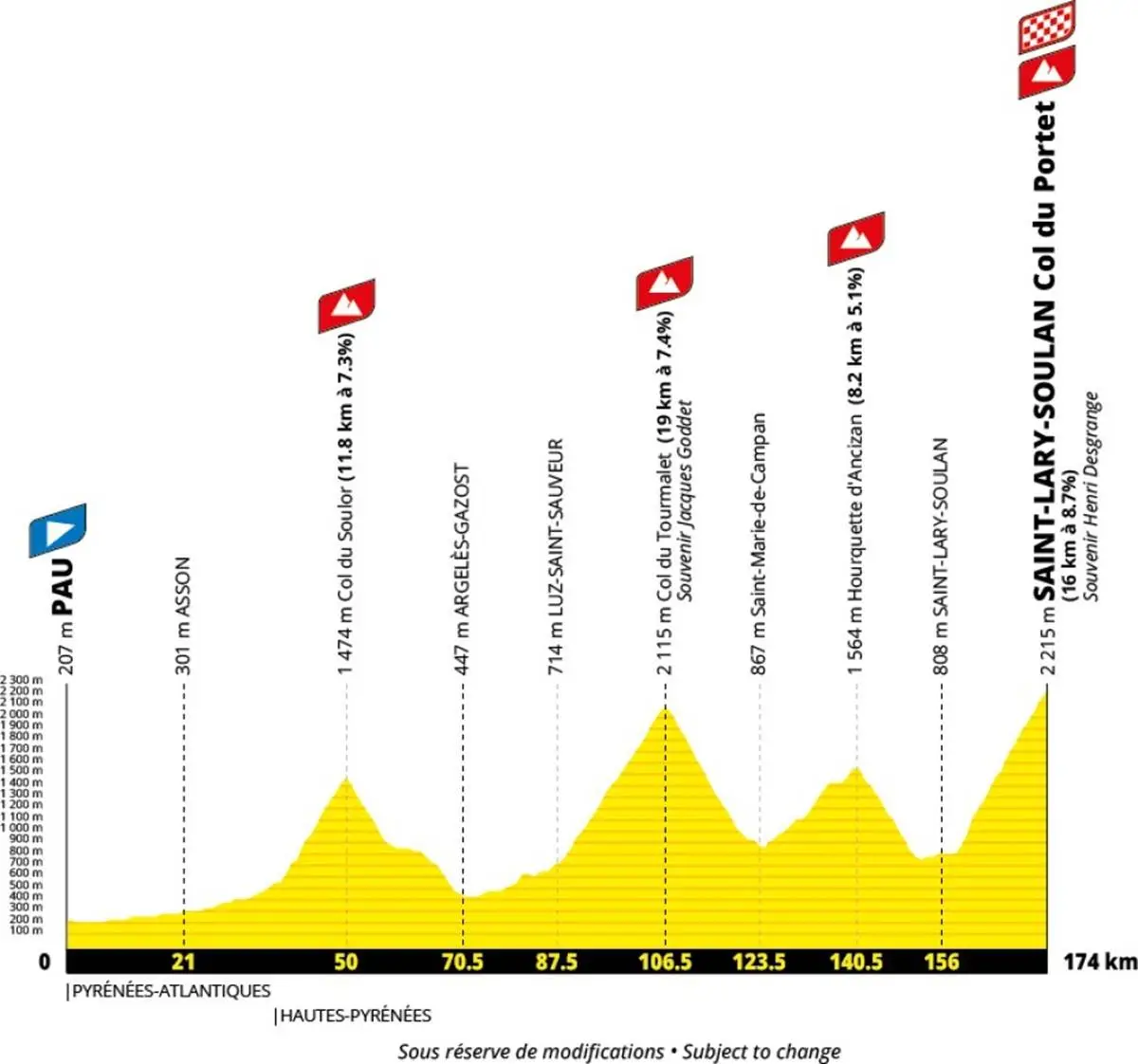
Pau - Col du Portet, 174 kilometers
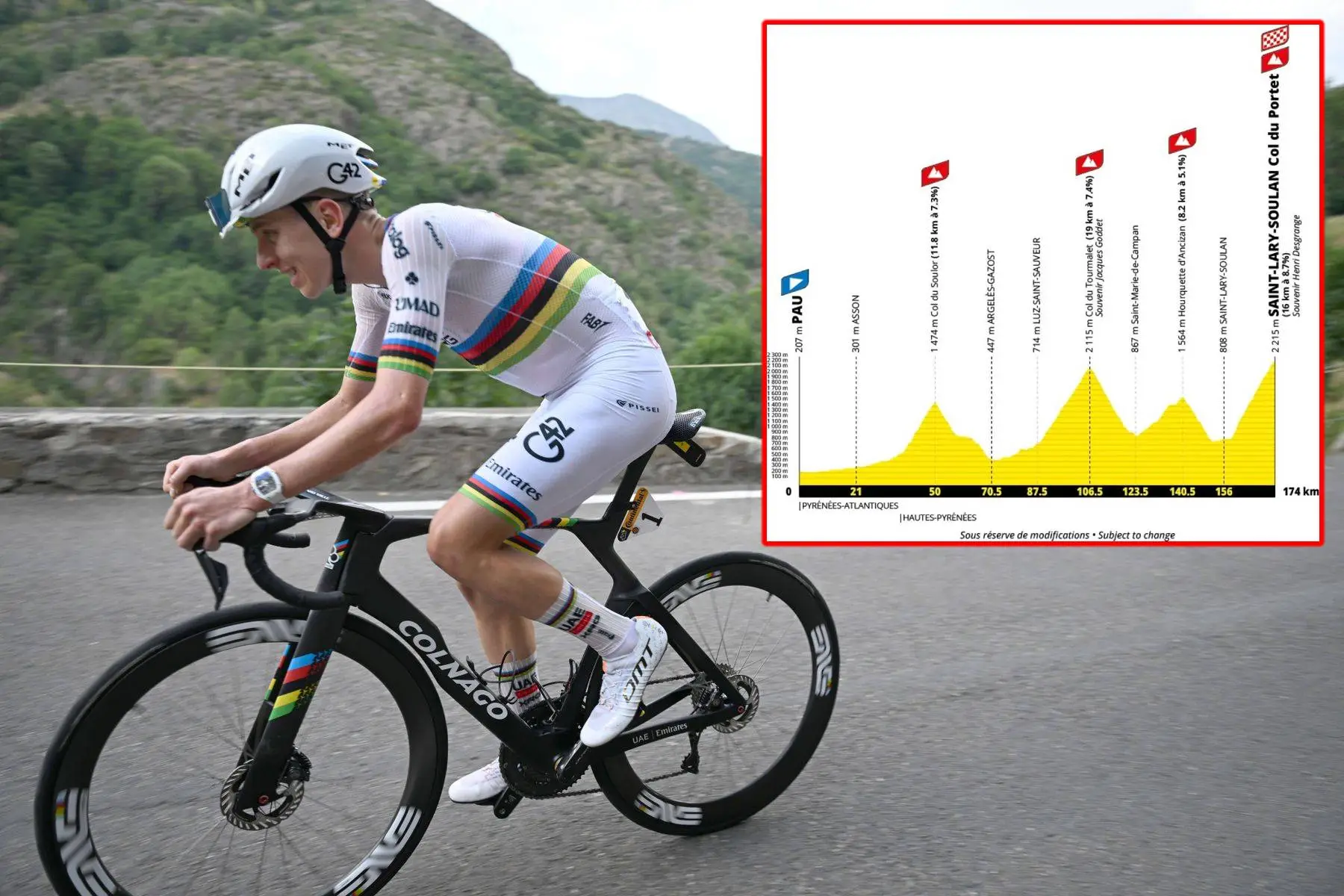
The fourth decisive stage of the Tour is what has been called by many its 'queen stage'. 5300 climbing meters make it the day where the peloton will climb the most, most of it within the final 140 kilometers - of the 174-kilometer long stage. Its the first day of climbing int he Pyrenees and features four big climbs, each split between long descents.
The riders go up the Col du Soulor, and then up the Col du Tourmalet - the mountain that has been climbed the most in the Tour's history. This will be enough to destroy the peloton, but represent only half of the day's climbing. The riders ascend the Hourquette d'Ancizan with 34 kilometers to go, before the day's highlight.
The stage will end in Saint-Lary-Soudal, up the Col du Portet. The ascent is 16 kilometers long, averages 8.7%, and features its summit at 2215 meters of altitude - the highest point of the entire race. The climb's average gradient is incredibly high and is very constant, meaning decisive attacks can occur at any point during the effort, which might prove crucial for the entire battle for the overall classification.
Stage 19: Hasparren - Lauruns

Hasparren - Laruns, 160 kilometers
The final mountain stage of the Tour steers clear from its traditional formula, featuring a day with three difficult climbs packed far from the finish. A short stage with a flat start within the French part of the Basque Country. Hence, the first climb of the day, the Col du Burdincurutcheta, is a prime example of what the region features best.
The climb will be 8.7 kilometers long at 9.3%, featuring incredibly steep gradients where the GC battle can erupt. The Col de Bagargui right after provides more climbing, but in shallower gradients in which tactical moves can take place. The riders will move deeper into the Col de Soudet, 15.1 kilometers long at 7.2%.
The longer ascent of the day is placed with 65 kilometers to go, and the long flat section that follows means that satelite riders can be crucial. The same can be said of the final ascent into the Col de Marie Blanque and the flat finale into Laruns.
It's a day that can be very tactical, with the final climb also being very steep - and most notably, being used by Jonas Vingegaard in 2023 to drop Tadej Pogacar. The climb is 7.7 kilometers long at 8.6%, but its final half averages around 12%.

Rúben SilvaEditor-in-Chief
A founding contributor to CyclingUpToDate since its launch in January 2022, Ruben Silva has played a central role in shaping the site’s editorial direction and long-term growth. Before joining the project, he built his experience through independent blogging at Echelons Hub and by producing race previews for Ciclismo Internacional, developing a strong analytical voice rooted in daily engagement with professional cycling.
Beyond editorial work, he has been closely involved in the expansion and coordination of CyclingUpToDate’s wider network, helping establish and support sister platforms across multiple languages. This includes ongoing collaboration with CiclismoAlDia (Spanish), CiclismoAtual (Portuguese), WielrennenUpToDate (Dutch), and RadsportAktuell (German), contributing to a shared editorial vision and consistent international coverage.
He also helps oversee editorial governance across the network, setting standards for accuracy and consistency and coordinating updates or corrections when needed.
Originally from the Porto metropolitan area in Portugal, he holds a bachelor’s degree in Geography. His path into cycling journalism was shaped not through formal media training, but through independent reporting, community engagement, and sustained on-the-ground involvement in the sport.
Over the course of his career, he has conducted approximately 100 interviews across road cycling and cyclocross, ranging from one-to-one conversations and online formats to press conferences and on-site pre- and post-race coverage. His interviews include leading riders, team managers, and prominent figures within cycling media: Tadej Pogacar, Jonas Vingegaard, Mathieu van der Poel, Primoz Roglic, Wout van Aert, Joao Almeida and Tom Pidcock; managers like Patrick Lefevere and Joxean Matxin; and YouTube personality Bryan Kennedy (BKXC)...
Within 18 months of launch, he helped grow CyclingUpToDate’s English-language platform into one of the most-read cycling news websites, built entirely from the ground up. As both a professional journalist and lifelong cycling enthusiast, his focus remains on delivering accurate, timely, and well-contextualized coverage.
claps 1visitors 1
Just in


Popular news


Latest comments
- When Thomas gets the bullet from INEOS he can get a job as a comedian.
 Senna196013-11-2026
- Right on. The more the merrier.Occam13-11-2026
- Remember, Del Toro struggled in this Tour. He is great, no doubt about that, but comparing him to a four time gt winner is absurd at this point. He has the potential. We'll have to see how he develops.awp13-11-2026
- what did Jonas gift and to whom? just curious, haven’t heard about this.mij13-11-2026
- You don't gift grand tours as it has come to light that Jonas has come to regret doing such.
 Front24213-11-2026
- Exactly you said it urslf - he outclimbed del toro by 19 sec. 19SEC and you say hes alot better than del toro still lol? And can also do the same where del toro did that to jonas even and del toro dauphine numbers better than jonas all year so why this hard whats the issue its super easy stuff - del toro wasnt that before. Then factor in both their trajectory the last years and the answer is self explonatory like i said. Nothing against jonas like many do but the typing is no the wall and so stupidly easy as its so self explanatory now. Have a good daymiguel13-11-2026
- Dirty ex doperFront24213-11-2026
- As far as points go they need to take a page or ten out of the Astana playbook!Lozza13-11-2026
- Ah, seems he’s been busy elsewhere! 😆Lozza13-11-2026
- Where is he when you need him!? Wake up man! You’re missing an opportunity!Lozza13-11-2026
Loading
Write a comment