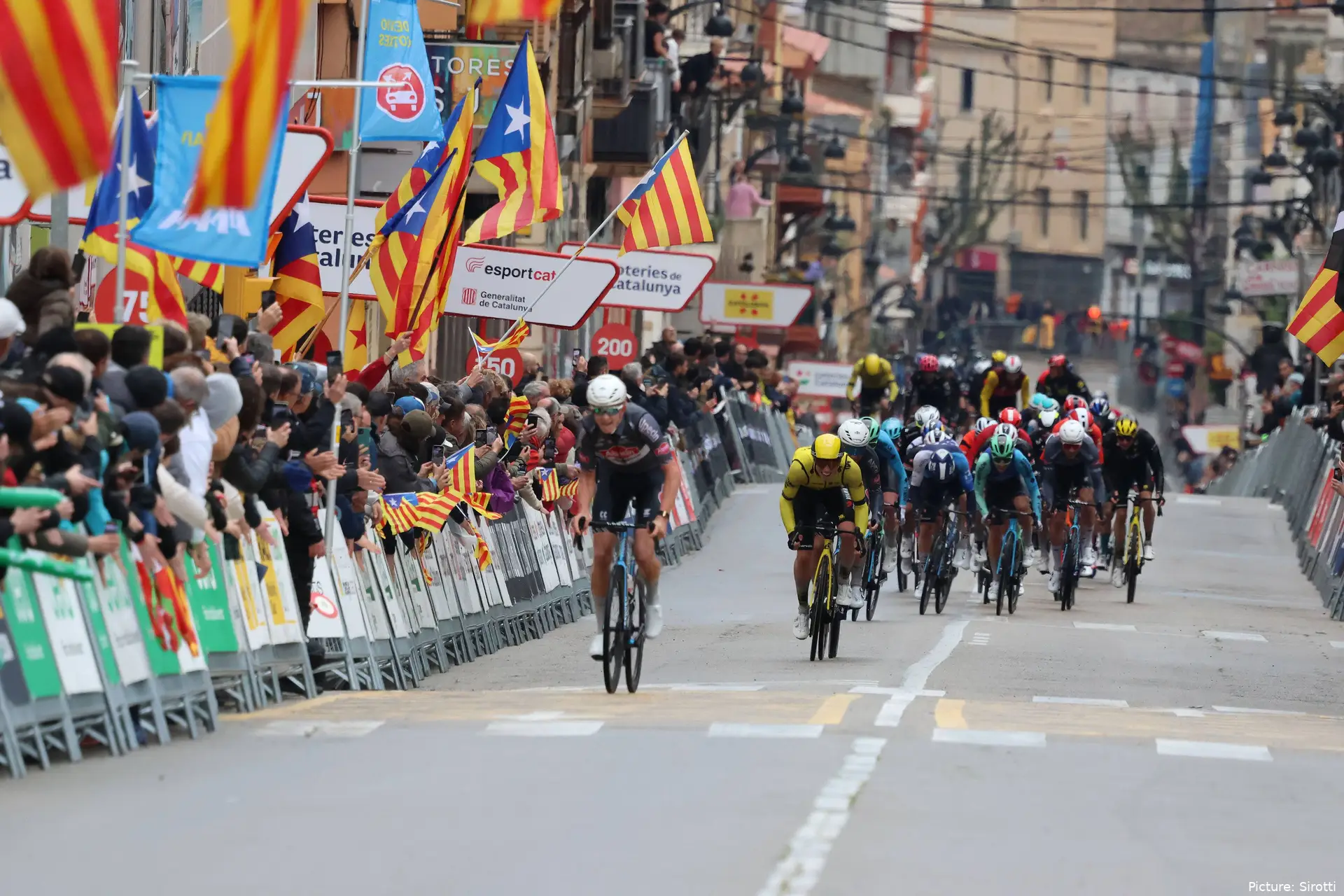
Catalunya will host a landmark date for world cycling in 2026. For the third time in its history, the Tour de France will start from Spain, with a Grand Depart firmly rooted in Catalunya. From the 4th to 6th of July, the opening three days will race on Catalan roads before the peloton heads into France.
Far from a gentle opener, the organisers have drawn up an explosive start that could create significant gaps in the general classification from day one. The blend of an innovative team time trial, a demanding medium-mountain stage with the Montjuïc circuit as judge, and a Pyrenean day towards Les Angles promises spectacle from the first flag drop.
The big favourites for yellow will have nowhere to hide. The race against the clock, Montjuïc’s punchy ramps, and the first summit finish will force the contenders to show their hand even before the first week is out.
The 2026 Tour, with Tadej Pogacar as the clear favourite and Jonas Vingegaard as the main challenger. And exciting names like Remco Evenepoel, Paul Seixas, Florian Lipowitz, Isaac del Toro, and Juan Ayuso among the starters, aims to break with conservative openings, and Catalunya is the perfect area for it.
| Stage | Route | Distance | Elevation gain | Features |
| 1 (Friday 04/07) | Barcelona - Barcelona | 19.6 km | 200 m | Team time trial |
| 2 (Saturday 05/07) | Tarragona - Barcelona | 168 km | 2,500 m | Medium mountains with Montjuïc circuit |
| 3 (Sunday 06/07) | Granollers - Les Angles | 195.6 km | 3,850 m | Medium mountain stage finishing in France |
Read also


Stage 1: A game-changing team time trial to open the Tour

Barcelona - Barcelona (TTT, 19.6 km)
The Grand Départ launches in Barcelona with a 19.6-kilometre team time trial featuring a major twist on the classic format. Teams will ride together against the clock, but times will be taken individually for each rider, a system successfully used at Paris–Nice since 2023.
The route packs 200 metres of elevation gain and finishes on the climb to Montjuïc, where the general classification favourites will need to show early form. A poor collective display or an individual crack could mean meaningful time losses from the outset.
Christian Prudhomme, the Tour de France director, underlines the innovative nature of the stage:
“The 2026 Tour de France begins with something new. The last team time trial was held in 2019 in Brussels, but this time teams will face a very different format. The approach of taking individual times in team time trials has been tested successfully at Paris–Nice since 2023. One thing is clear: in this first test the favourites won’t be able to hide. The Montjuïc finale will reveal the strongest.”
Stage 2: Montjuïc once again decides among the best

Barcelona - Tarragona (168 km)
Day two takes the peloton from Tarragona to Barcelona over 168 kilometres with 2,500 metres of elevation gain. The headline act is the final Montjuïc circuit, a mythical Catalan cycling venue that often decides the Volta a Catalunya - however with a finale that is more difficult than what is traditionally seen on TV.
Relentless rises and drops, coupled with the day’s accumulated fatigue, make it prime ground for explosive riders and short-power specialists. Time gaps from the team time trial could also trigger early tactical moves.
Prudhomme does not hide the route’s sting:
“The Montjuïc hill is one of cycling’s essential backdrops, especially as it often hosts the Volta a Catalunya’s final finish. The most powerful puncheurs will feel at home here: the last three winners on Montjuïc, Primoz Roglic (2025), Tadej Pogacar (2024) and Remco Evenepoel (2023), sketch the portrait of the likely victor. The accumulation of difficulties in the closing laps makes the circuit even more draining than in the Catalan spring appointment.”
Stage 3: first mountain battle en route to Les Angles

Granollers - Les Angles (195 km)
Stage three bids farewell to Catalonia and crosses into France. Starting in Granollers and finishing at the Les Angles ski station, the peloton will cover 195.6 kilometres and around 3,850 metres of climbing on a day with a clear taste of high mountains.
Before the French border, the riders must clear the first-category Toses (9.3 km at 6.5%) before heading deeper into the Pyrenean massif. Although the Les Angles finish climb is relatively short — 1.7 kilometres at 7% average — the day’s accumulated wear could still open gaps at the line.
For Prudhomme, the profile invites both GC skirmishes and a breakaway with a real shot:
“The assault on the Pyrenean massif on day three promises a carousel of protagonists, and the stage profile may well favour a baroudeurs’ break rather than a mobilisation of the world’s best climbers. Despite the stage’s 3,850 m of elevation gain and the ascent of the Col de Toses before leaving Spain, the visit to the plateaus around Font-Romeu and the climb to Les Angles (1.7 km at a 6.5% average) will likely serve as a springboard for a surprise guest.”

Juan LarraCycling Journalist
Juan Larra is a writer for Cyclinguptodate and editor-in-chief of Ciclismoaldia, where he has played a central role since its inception. Under his leadership, the website has become a trusted source for professional cycling coverage, offering in-depth analysis, news, and feature stories.
A sports journalist with over 20 years of experience, Juan earned his degree in Journalism from the University of Seville in 2007. He began his career covering a wide range of sports—including football, basketball, Formula 1, MotoGP, tennis, and cycling—for platforms such as the official La Liga app, Vodafone and Movistar websites, NBA Blogdebasket, and Cadena Cope, honing his skills in writing and editorial management.
In addition to his work at Ciclismoaldia, Juan contributes to Cyclinguptodate and serves as editor-in-chief for the tennis-focused site Tenisaldia. Throughout his career, he has conducted exclusive interviews with cyclists and sports figures, provided detailed analysis of competitions ranging from local Spanish races to major international events, and acted as a special correspondent at prestigious races including Paris-Roubaix, the Tour de France, and the Vuelta a España.
Juan’s combination of experience, expertise, and direct access to athletes has established him—and the platforms he leads—as authoritative voices in professional cycling.
claps 0visitors 0
Just in

Popular news
Latest comments
- It doesnt take a genius to understand that Pogi is 1 level above and Pogi is younger that Jonas, so Jonas will not win under ordinary circumstances. Pogi has to crack hard for Jonas to win. It doesn't matter whether you defend Jonas or not , facts remain facts. Jonas himself says his numbers are better than 2022/2023, so Jonas is more or less optimized and we are just see the stochastic variation due to other factors. I think he will retire along with Pedersen in WC denmarkabstractengineer13-11-2026
- They only raced each other during the 2026 Tour, but here's a few metrics to look at. Stage 3 (Granollers to Les Angles): Pogačar won the stage, finishing 2 seconds ahead of Vingegaard (2nd). Del Toro finished 24 seconds behind Stage 6 (Pau to Gavarnie-Gedre / Col du Tourmalet): Pogačar won solo, Vingegaard finished 2nd (losing 2:38), and Del Toro finished 3rd (at +2:57, finishing 19 seconds behind Vingegaard). Here, Jonas Vingegaard outclimbed Isaac del Toro by 19 seconds on the mountain stageawp13-11-2026
- your clinging to the past. Jonas was dropped by del toro many times last year and jonas never managed a climbing numers del toro did in dauphine last year -entire year. Trend is also evident theres no discussion your living in the past, its beent he same with jonas for many years now and only developing, meanwhile del toro is rising and developing greatly. This is all obvious stuff and im not even a del toro fan. No point discussing numbers or this i suspect you dont watch much now but rather think its 2022 still cause this aint hard.miguel13-11-2026
- We can go through metrics if you like, Del Toro, who I do admire and support, is not on the same level as Jonas just yet. You will see that in early 2027 if they have any crossover races. I do hope they both race the Giro. You are correct though, Jonas is getting older and will not be able to hand on much longer. I see 2027 as a good year for him. Obviously behind Tadej though.awp13-11-2026
- What wins? Are you LA operating under a pseudonym?mij13-11-2026
- My point is this - Tadej, Remco, Seixas are all the outliers. Many riders don’t hit their peak until 28. It’s way too early to write him off. And the pogi slo guy that hates him - he’s also immature. Ayuso needs time.mij13-11-2026
- Then you need to use ur eyes or head if you have cause del toro already dropped jonas two times and beat him in tdf stages already this year.. Del toro climbed(dauphine) better numbers than jonas did all year too. So ur feelings and wishful thinking doesnt amtter del toro himself has already surpassed jonas infact just facts. Its also very evident for anyone objective that Jonas is declining alot, its just the truth and super obvious.miguel13-11-2026
- None of those victories stand, so there's that,wrsty13-11-2026
- No surprise there; it is British Sycling, yes, with an S
 Rafionain-Glas12-11-2026
- I like Del Toro but he's not on the level of Jonas, by a large margin.awp12-11-2026
Loading
1 Comments