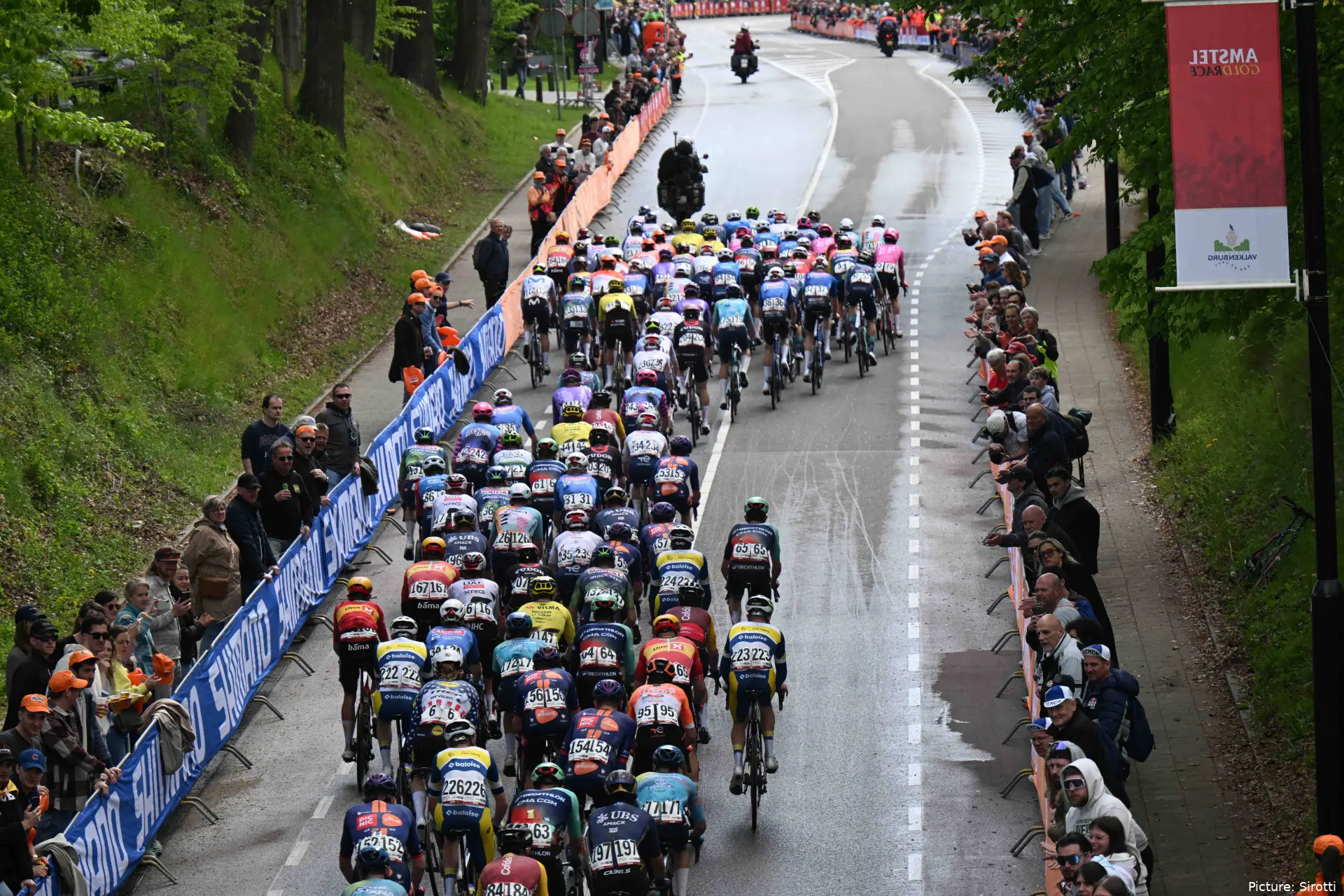
A Tuesday stage in the Vuelta, with no sprint finish and no big names fighting for the jersey, rarely makes headlines. Yet somewhere a fan is checking who will take the third intermediate sprint, or which team will place two riders in the breakaway. That kind of curiosity is exactly what modern betting markets are built around.
Cycling is hard to price. A peloton of 176 riders, shifting weather, crashes, team orders and mountain profiles create thousands of variables. Operators that run sports betting software can break a three-week race into small, readable questions, so a fan who follows the sport closely finds something worth a look on every stage, not just on summit finishes.
Why Cycling Is a Tough Sport to Turn Into Markets
Football gives a pricing team a simple frame: two sides, ninety minutes, a handful of outcomes. A bike race offers none of that. The winner of a flat stage might come from a bunch of 150 riders, and the winner of a mountain stage from a group of six.
Trading teams therefore lean on rider-level history. Climbing speed on gradients above 8 percent, results on cobbles, time-trial power numbers and even how a team performs in crosswinds all feed the model. A rider's form in the week before a race matters as much as his career record.
- Stage profile: flat, rolling, mountain or time trial, each with its own price logic.
- Job description: a GC captain, a lead-out man and a water carrier all ride the same road for different reasons.
- Team strategy: who works for whom, and who is allowed to chase a stage win.
- Conditions: wind direction, temperature and road surface on the day.
Market Types That Make a Stage Worth Following
Slicing a three-week Grand Tour into twenty-one separate puzzles is where the real appeal lies. Instead of a single bet on the overall winner, a platform can publish markets for each stage, each climb and each sprint, so interest stays alive after the favourite loses time on day four.
| Market type | What it covers | Why fans engage with it |
| Stage winner | First rider across the line | Works on every profile, from sprints to summits |
| Head-to-head | Two riders compared over a stage | Easy to grasp, ideal for rivalries |
| Mountain classification | Best climber over the full race | Keeps hill days interesting for weeks |
| Top 3 or top 10 | Podium or top-ten finish | Gives outsiders a realistic angle |
| Team prop | Which team has the most riders in the break | Rewards close attention to tactics |
The head-to-head format deserves a special mention. A fan may have no idea who wins the Tour, yet feel strongly that one climber beats another on a single ascent. Two names, one outcome, no jargon.
What the Technology Does Behind the Scenes
A good cycling product is mostly invisible. The fan sees a clean list of stages; the operator sees a stack of tools that keeps it running.
Live data and in-race pricing
Races move in bursts. A rider attacks at kilometre 160 and the picture changes within a minute. Platforms ingest live feeds from timing providers and update prices as gaps open or close, which keeps in-play markets usable instead of leaving them suspended for half a stage.
Personalisation for small audiences
Cycling audiences are loyal but small, so showing everyone the same page wastes space. A platform can surface a Giro d'Italia stage to someone who followed the Classics, and a track cycling market to someone who watched the Olympic velodrome. Content, odds boosters and notifications can be matched to what each person has actually looked at before. Done well, this turns a niche calendar into a steady series of small events. The same logic already works for darts, handball and esports, and cycling, with its natural storylines of rivalry, redemption and long-range tactics, suits it better than most.
For cycling media, the takeaway is simple: the sport's complexity is not a barrier but raw material. Every breakaway, every wind split and every mountain duel is a market waiting for a clear question. Picture the Milan–San Remo finish, where the Poggio climb lasts barely four minutes yet decides the whole day. A platform that prices that single hill separately, with a market on who attacks first and another on who survives the descent, gives a four-minute moment the weight of a full match. That is the craft: noticing where the sport already tells a story, then handing fans a precise, readable way to follow it.

Kieran WoodDeputy Editor-in-Chief
Kieran Wood is a sports journalist based in Wales and has been active in journalism since 2022. He regularly contributes to DartsNews.com and CyclingUpToDate.com, where he covers professional cycling and darts. In cycling, his work includes liveblogs from major races, including the Tour de France, the Giro d’Italia, and La Vuelta a España, alongside race reports and analysis. He has also conducted interviews with professional riders.
His reporting spans the full racing calendar, from one-day classics to stage races, with a focus on accurate, real-time coverage and clear contextual analysis. For statistics, results, and historical context, he regularly uses resources such as ProCyclingStats. To support reporting on rider activity and training context where relevant, he also references Strava.
In his work, Kieran places strong emphasis on careful sourcing, editorial accuracy, and updating articles as new, verified information becomes available.
claps 0visitors 0
Just in


Popular news

Latest comments
- All journalists should start asking the UCI uncomfortable questions, sending inquiries about the interpretation of the rules and the justification of the results. This is the only way to change anything.averagecyclist09-11-2026
- OFF TOPIC: OK, don't get mad with me... I have some very important news, something that can't be overlooked, something that can't be ignored!!! In the new documentary Anatomy of a G.O.A.T. (released in November 2026), legendary Belgian cyclist Eddy Merckx spoke about Tadej Pogačar: “He has revived a style of cycling that we had almost forgotten. He is now better than me.” Key statements by Eddy Merckx about Pogačar in 2026: - Acknowledging his superiority: This time, Merckx openly admitted, without any subsequent backtracking or reservations, that Pogačar had surpassed him and was now above him. This contrasts with 2024, when he quickly softened his remarks about Pogačar being faster. - The possibility of a historic treble (Giro, Tour and Vuelta): During the July Tour de France (where Pogačar claimed his fifth title), Merckx stated that Pogačar was the only cyclist in history capable of winning all three Grand Tours (the Giro d'Italia, Tour de France and Vuelta a España) in a single season, provided the conditions were right and he had sufficient team support. - Lack of serious competition: Merckx emphasised that Pogačar has no real rivals in the mountains, thanks to his extraordinary climbing ability and the fact that he continues to improve despite still being under 28 (he turned 28, or passed that age, in autumn 2026). - Praise for his racing style: He highlighted how Pogačar is bringing back the aggressive, uncompromising spirit of cycling's golden era, when races were not merely about calculated stages and tactical conservatism, but about attacking from long distances. PS: Now, this is real important cycling news. Capish?PogiSloFans09-11-2026
- how else is there to look at things? we are responding to words and pictures, we are not there. your long winded replies make zero sense to anyone. pretty much everyone but you says the same thing. MS was robbed. somehow you think you're so smart to dig beneath the surface and discover something no one else, including the opposing coach and cyclist, saw. lol. you are a tool.mij09-11-2026
- Pidcock finished 9th place, 29 minutes down. he is a helluva rider, so gutsy. and he is amazing at all disciplines. but this headline is . . .mij09-11-2026
- I know, watch the video. and listen to her competitors. it was a tricky tacky call at best. WTF is this guy talking about??? my original comment was from the picture it didn't look like anything.mij09-11-2026
- I dunno what you're talking about. you make no sense. MS's competitor and the competitors coach said it was BS. she didn't deviate in a way that relegation should be required. revel LOL. you're so cool, in your own mind.mij09-11-2026
- deviation lol, watch the videomij09-11-2026
- the 'No different than women who follow and discuss celebs through gossip magazines' comment was unfortunately a bit off. didn't you just boast about your principles in the comments section of another article?Ketterechts08-11-2026
- Are you MrMauMau 2.0? Nothing you are saying is really relevant. Vaguely connected, but irrelevant. The conversation is whether Schreiber impeded Brand or not.
 Rafionain-Glas08-11-2026
- He is boring
 leedorney08-11-2026
Loading